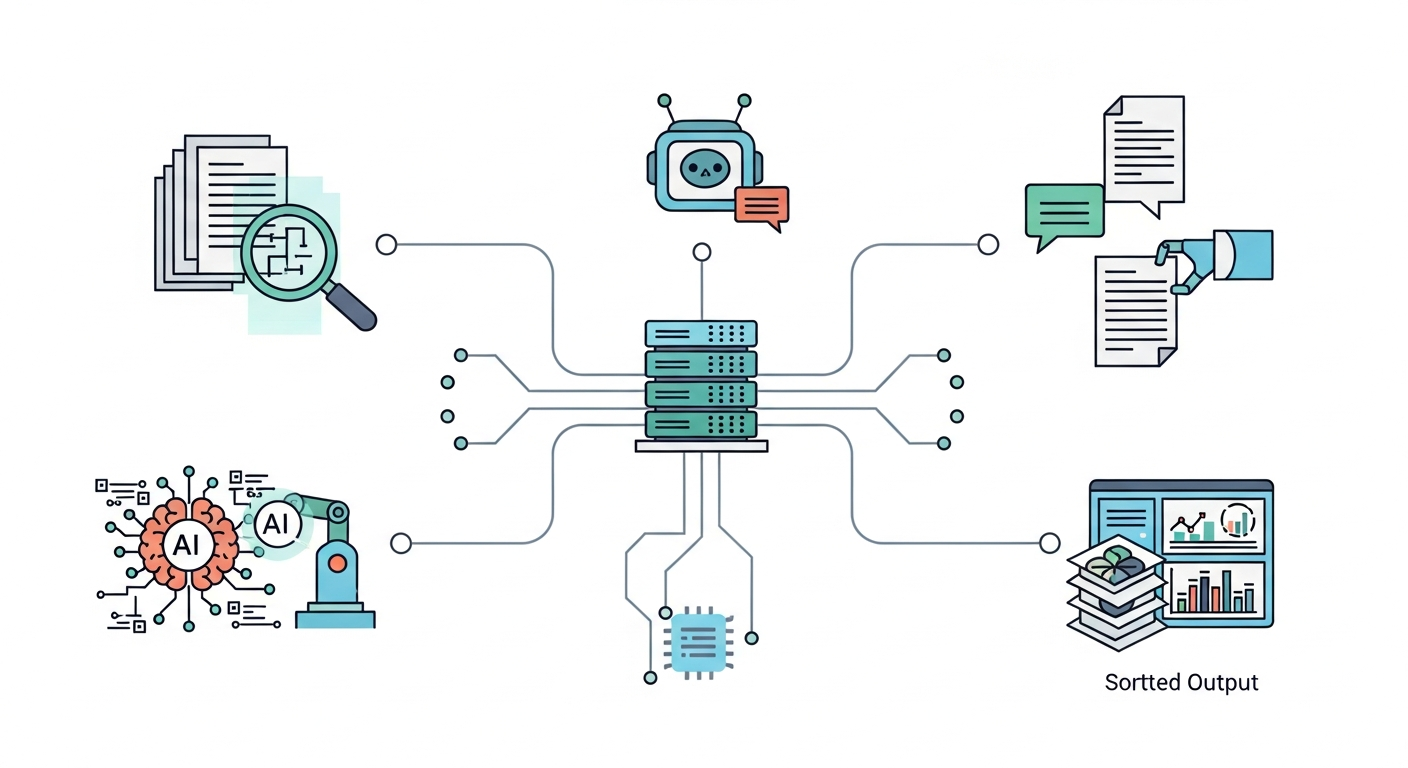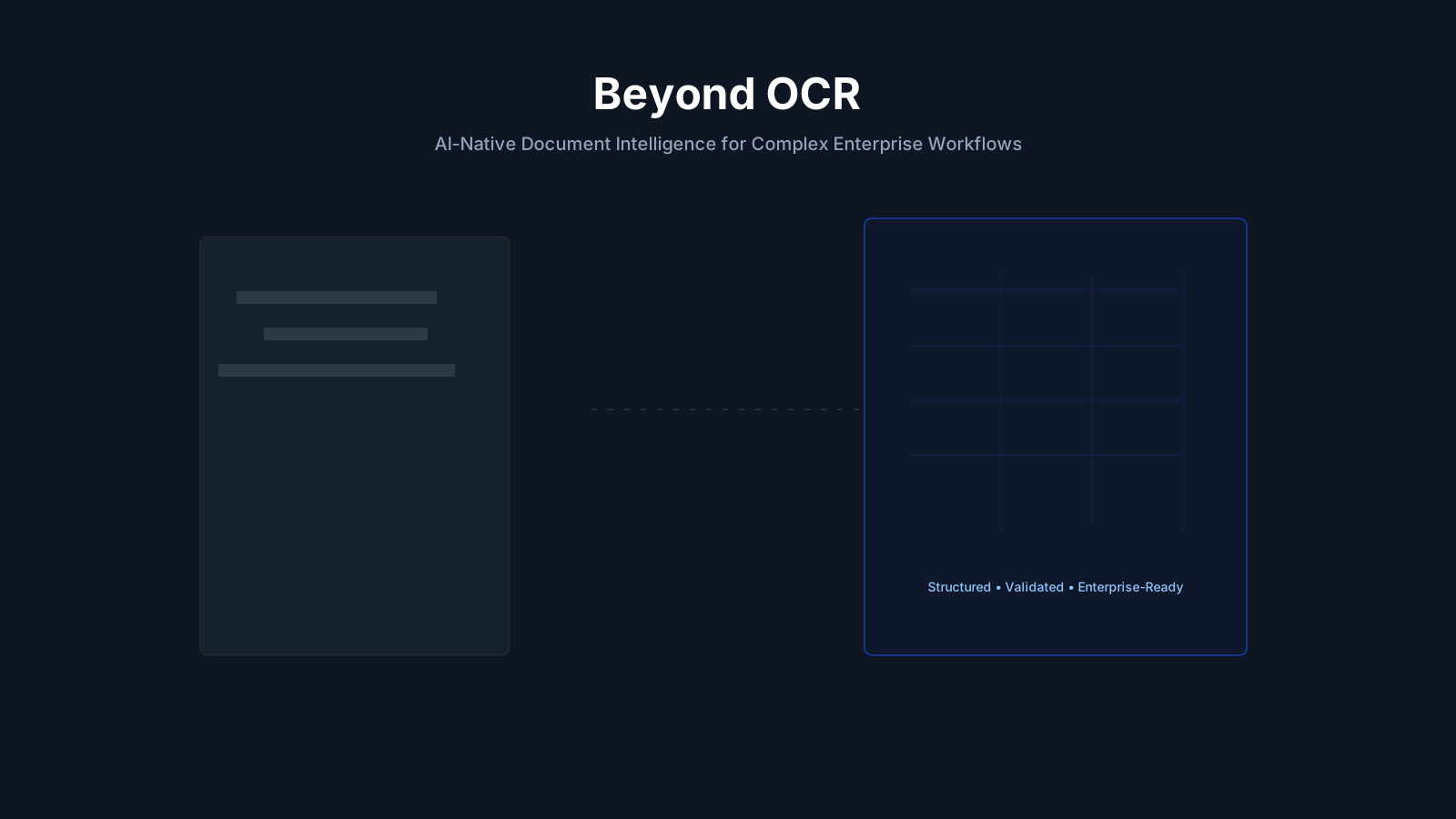
Intelligent document processing (IDP) uses AI to automate data extraction, classification, and validation from documents. Think of it as replacing manual data entry from invoices, COAs, and contracts with a system that understands the document's meaning, not just reading the text.
IDP leverages large language models, computer vision, and natural language processing to turn unstructured documents into structured, usable data. This goes beyond traditional OCR, which simply reads text; IDP understands the context and relationships within the document. Ameya focuses on this understanding and validation, because that’s where most document workflows break down.
Why Traditional OCR Struggles with Complex Documents
If you've dealt with document-heavy processes, you know OCR's limitations firsthand. Traditional OCR often fails when layouts change or documents aren't perfectly formatted. I've seen this repeatedly in my 26+ years in Enterprise IT.
Here's where traditional OCR typically falls short:
Template dependency: Most OCR tools require mapping data fields to specific locations on a document. Vendor name in the top-left, total at the bottom-right. The problem? Suppliers change formats constantly. In industries like food manufacturing, a company might receive COAs in hundreds of layouts.
Training data bottlenecks: Some AI-powered OCR tools are better, but they still need a lot of training data. Often, you need 20–100 labeled samples per format before extraction is reliable. Imagine needing thousands of manually annotated documents just to handle 500 different supplier layouts.
The validation gap: Even with perfect text extraction, OCR often stops there. Knowing a COA says "5.2%" is meaningless without context. Is 5.2% moisture acceptable for this product? Does the microbial count meet the required specifications? Traditional OCR tools leave this crucial comparison to your team, opening the door to errors.
Ameya Extract: Template-Free Document Processing
Ameya Extract, developed by KnowAll AI Technologies Inc., is designed to overcome these challenges. It's an enterprise IDP platform that uses large language models to extract structured data from any document format, without templates, training data, or manual configuration.
Here’s how it works:
Step 1: Define a schema. Choose from pre-built document types (invoice, COA, bank statement, etc.) or visually define a custom extraction schema. No coding needed.
Step 2: Upload documents. Send documents via upload, email, or API. Ameya handles PDFs, DOCX, XLSX, and scanned images.
Step 3: Get structured data. Ameya returns extracted data in real time via API or webhook, ready for integration with your ERP system.
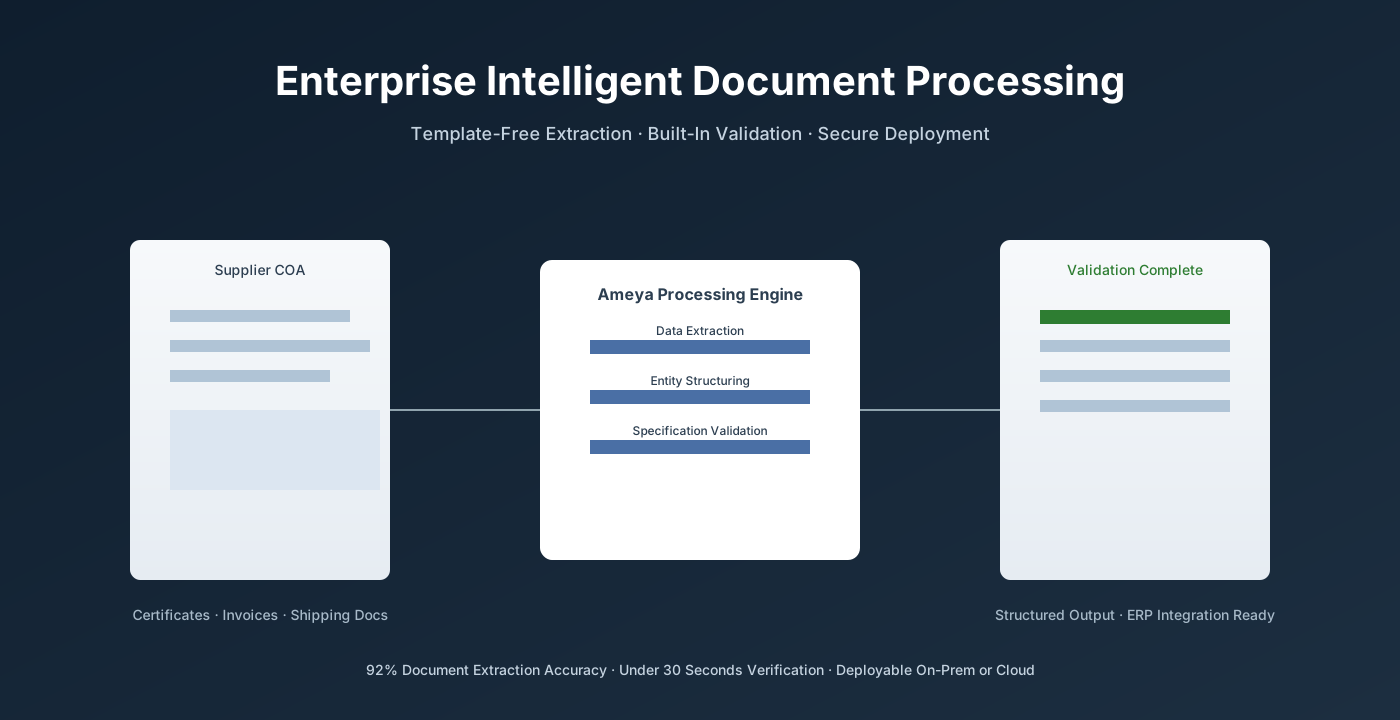
Unlike traditional OCR, Ameya reads documents contextually. It identifies entities like test parameters, values, and units based on meaning and semantic relationships. This means a COA from a new supplier can be processed instantly, without any setup.
Accuracy on Complex Documents: The Smart Food Safe Case Study
In a case study with Smart Food Safe, a food safety and quality management platform, Ameya Extract achieved:
- 92% extraction accuracy on previously unseen COA formats, with no templates or training.
- Under 30 seconds per COA verification, compared to manual reviews taking minutes or hours.
- 95% faster end-to-end COA verification.
- Automatic spec validation: Extracted values are compared against product specifications within the same workflow.
Prasant Prusty, Founder of Smart Food Safe, noted that Ameya's AI capabilities empowered their clients to eliminate manual data verification from their supply chain workflows.
A note on accuracy: While 92% accuracy without configuration is strong, it also means roughly 1 in 12 extractions might need review. For critical documents like food safety COAs, Ameya supports human-in-the-loop review. Accuracy improves as the system learns from your specific document types.
What Sets Ameya Apart from OCR and Other IDP Platforms?
Three key capabilities distinguish Ameya:
1. Entity-Level Understanding
Traditional OCR recognizes characters. Ameya understands the relationships between them.
Imagine a COA with test results across multiple pages. Traditional OCR might extract all the numbers, but it won't link each test parameter to its value, unit, and specification range. Ameya understands these relationships, such as "this number is the moisture content, measured in percentage, for a specific batch" because it reads context, not just characters.
This entity-level understanding is crucial for handling variable layouts, multilingual content, scanned originals, and mixed-format pages.
2. Built-In Validation Against Business Rules
This is where Ameya truly shines. Extraction and validation are integrated into a single workflow.
When Ameya extracts values from a COA, it automatically compares them against your product specifications. If the moisture content should be below 4%, and the COA reports 5.2%, the system flags it before the data reaches your ERP.
This eliminates manual cross-referencing, preventing costly quality and compliance errors. Plus, you can audit every comparison.
3. Flexible Deployment with LLM Choice
Ameya is built on Kubernetes and can be deployed on any cloud environment or on-premises. You can choose between commercial LLMs or deploy open-source models in your own data center.
This flexibility is critical for regulated industries like food safety, financial services, and healthcare, where document data can't leave your infrastructure. Realm-based access controls enable security policies and data segregation per team.
Ameya vs. Google Document AI, ABBYY, and Others
Here's a comparison to help you evaluate your options:
| Capability | Traditional OCR | AI-Powered IDP (ABBYY, Google Document AI) | Ameya Extract |
|---|---|---|---|
| Template required? | Yes | Sometimes | No |
| Training data needed? | Extensive | 10–100 labeled samples per format | None |
| Spec validation built-in? | No | Rarely | Yes |
| Multilingual support | Limited | Broad | Yes |
| On-premises deployment | Varies | Limited (Google is cloud-only) | Yes |
| LLM choice | N/A | Vendor-locked | Commercial or open-source LLMs |
| AI agents for support | No | No | Yes |
| Published accuracy | 85–92% (with templates) | 90–99% (with training) | 92% (zero-configuration, Smart Food Safe case study) |
Ameya is best for: High document format diversity, COA and quality document processing, integrated spec validation, and on-premises deployment needs.
Competitors may lead in: Larger integration ecosystems, longer public track records, established compliance certifications, and broader handwriting recognition benchmarks.
Security certifications: While Ameya offers enterprise-grade security and access controls, specific compliance certifications aren't publicly listed. If SOC 2 or ISO 27001 are required, ask the Ameya team directly.
Supported Document Types
Ameya Extract includes pre-built extractors for:
- Invoices: Vendor details, line items, totals, tax, payment terms.
- Certificates of Analysis (COAs): Test parameters, values, units, batch numbers, spec compliance.
- Bank statements: Transactions, balances, account details.
- Shipping documents: Bill of lading, packing lists, carrier details.
- Customs declarations: HS codes, declared values, country of origin.
- Trade documents: Letters of credit, certificates of origin.
For other document types, use the visual schema builder to define custom extraction fields.
Ameya AI Agents for Customer and Vendor Support
The Ameya AI platform also includes AI agents for customer and vendor interactions.
Ameya AI Agents are trained on your SOPs, product specs, and knowledge base. They handle queries across web, chat, and voice, answering questions about order status, product specifications, and compliance documentation.
Published performance metrics:
- 60% reduction in average handle time (AHT)
- 70% self-service resolution rate
- 30% cost savings in customer operations
Transparency note: These metrics are published on Ameya's website but aren't attributed to a specific named customer, unlike the Smart Food Safe data. Ask the Ameya team for more context.
Is Ameya Right for You?
Ameya is a good fit if:
- You process documents from many suppliers with unique layouts.
- You need extraction AND validation.
- You require on-premises or private cloud deployment.
- You want document AI and customer support AI agents on one platform.
- You can't afford the setup time for templates or training data.
A simpler tool might be enough if:
- You process a small number of standardized document formats.
- You only need basic text extraction.
- You're already heavily invested in Google Cloud or Microsoft.
Evaluating Any Document AI Platform
Here's how to evaluate Ameya or any IDP platform:
Test with your own documents. Upload your most challenging supplier documents and measure accuracy. Ameya's free trial lets you do this quickly.
Ask for customer references. A case study is just a start. Talk to a customer in your industry.
Understand the exception workflow. No AI is perfect. See how reviewers correct extractions and whether the system learns from those corrections.
Verify security claims. Ask for SOC 2 reports, penetration test results, or data processing agreements.
Test the validation workflow. Upload a document with out-of-spec values and see if the system flags them.
Measure total cost of ownership. Factor in template maintenance, training data preparation, integration effort, and the cost of manual review.
Frequently Asked Questions
What's the difference between OCR and IDP? OCR converts images to text. IDP understands document structure, extracts data, classifies documents, and validates data against business rules.
Can Ameya process unseen documents? Yes. Ameya uses large language models to read documents contextually.
What accuracy does Ameya achieve? 92% extraction accuracy on unseen COA formats in the Smart Food Safe case study.
Does Ameya work with my ERP system? Yes. Ameya delivers data via API or webhook for integration with ERP systems.
Can Ameya be deployed on-premises? Yes. Ameya is built on Kubernetes and can be deployed anywhere, with a choice of LLMs.
What industries use Ameya? Food safety, finance, logistics, and cross-functional operations.
How is Ameya different from Google Document AI or ABBYY? Template-free extraction, built-in spec validation, flexible deployment, and integrated AI agents.
Get Started
Try Ameya Extract free and upload a document to see the results.
If the results are good, book a strategy call to discuss your specific needs.
If the results aren't strong enough, you'll know quickly. That's the goal.
Ameya AI is an enterprise document intelligence and AI platform built by KnowAll AI Technologies Inc.