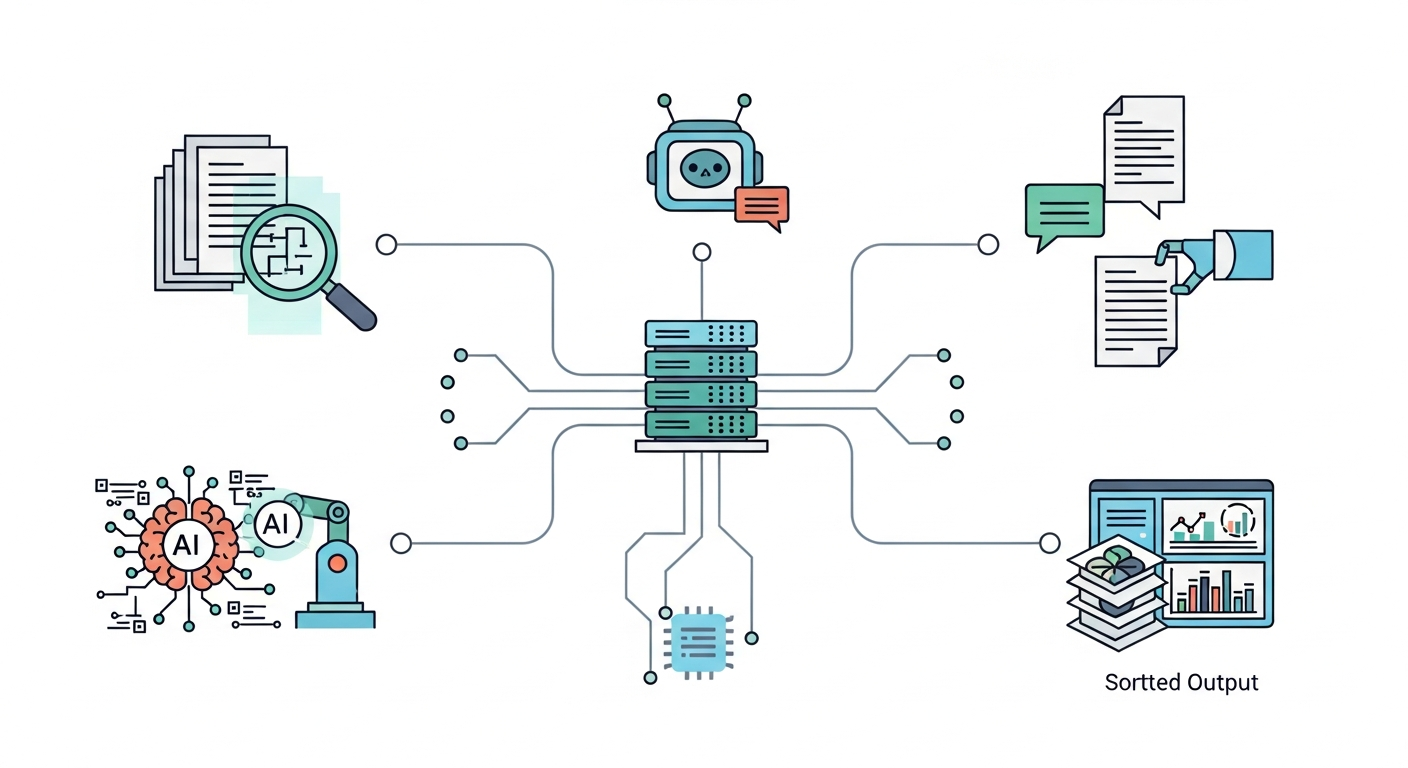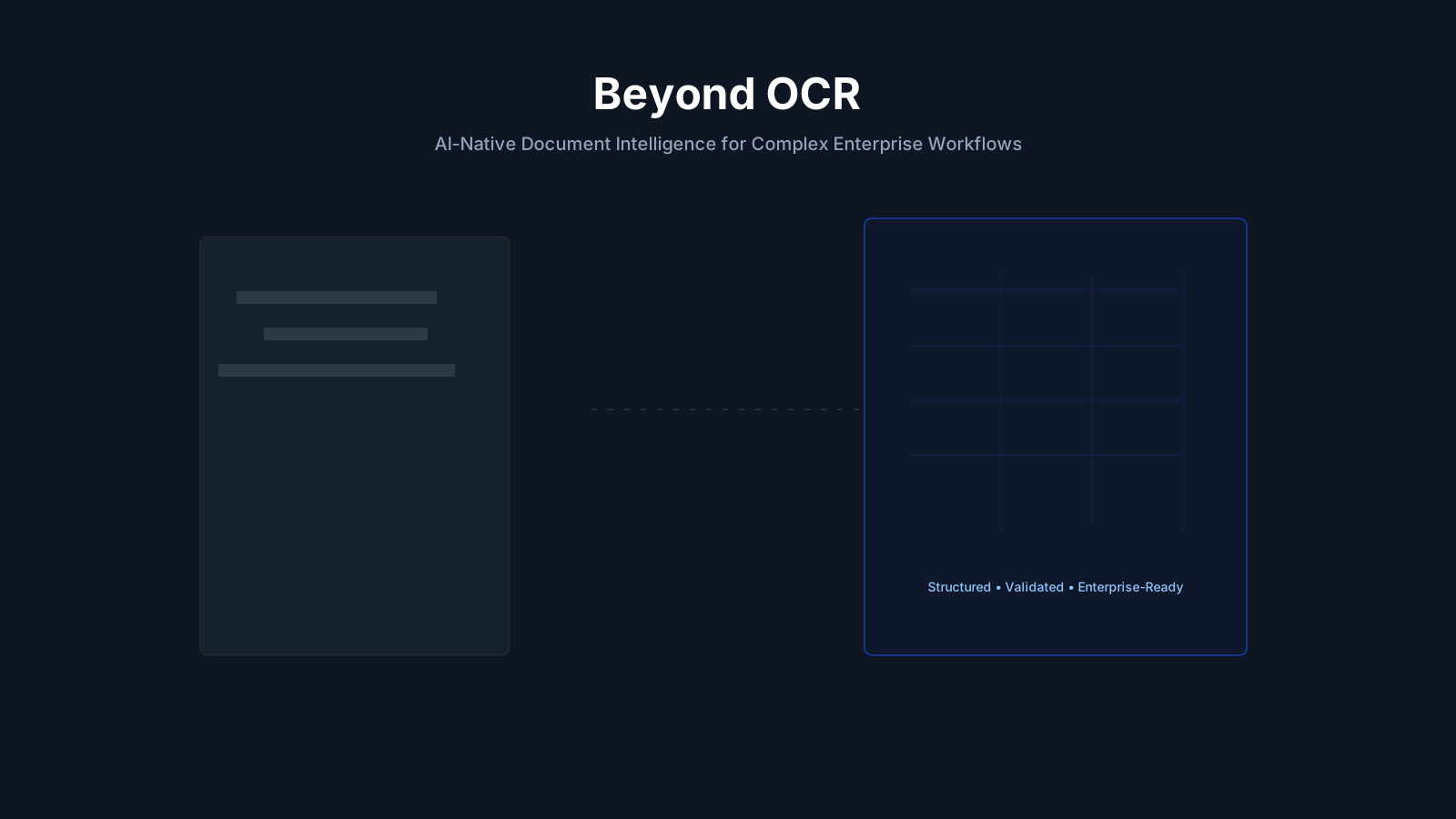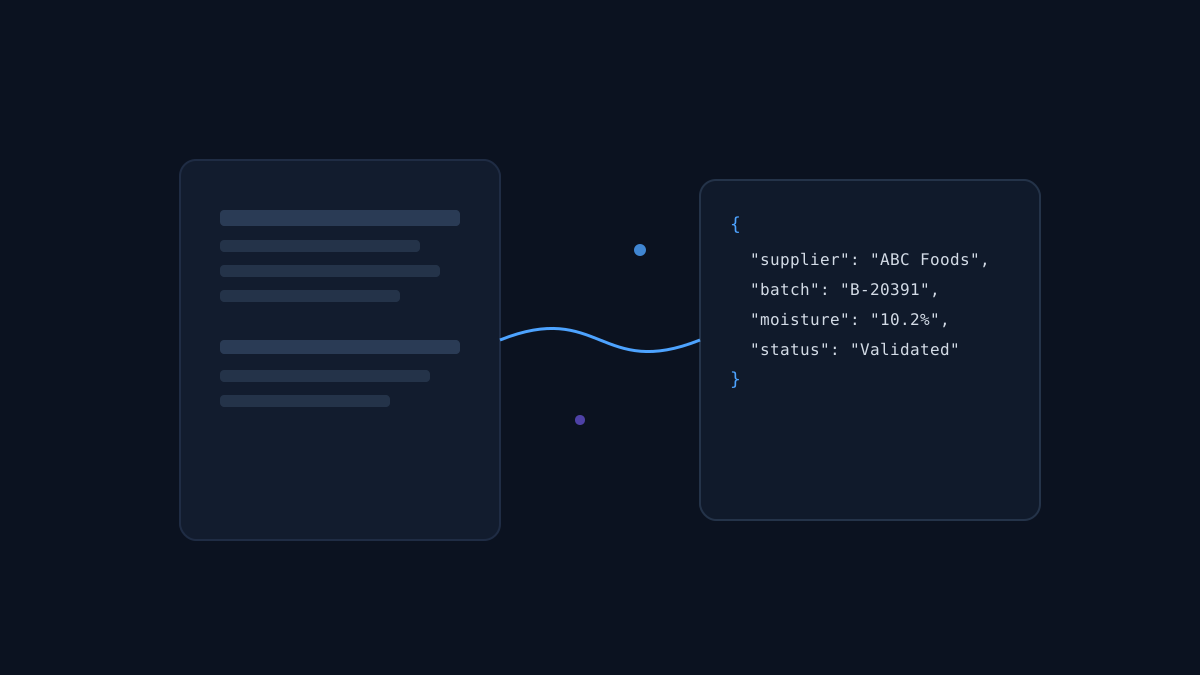
Document parsing programmatically reads files like PDFs and spreadsheets, turning unstructured content into clean, usable data. Think of it as the technology that answers the question: "What information is in this document, and where should that information go?"
Here's a quick breakdown of how document parsing has evolved:
Rule-based/template parsers: Imagine drawing boxes around data fields on a document. That's how these parsers work. If the layout changes even slightly, the parser breaks. These were common in the 2000s.
Machine learning (ML) parsers: These learn from hundreds of annotated examples to locate data. They're more flexible than template parsers, but require a lot of upfront work and ongoing retraining.
LLM-powered intelligent parsers: This is the current state of the art. They understand document content semantically, identifying what data means rather than where it sits on the page. This is the approach we use at Ameya Extract: define what you want, upload a document, and get structured output. No templates, no training.
Why Document Parsing Matters to Operations Teams
Manual document processing hits enterprises where it hurts: the bottom line. It leads to wasted labor, error correction costs, and delayed decisions.
Consider a food manufacturer processing 500 Certificates of Analysis (COAs) weekly. Each COA, from a different supplier, has a unique layout, but each contains critical quality data that must be verified before raw materials are accepted.
Manually, this verification takes 8–15 minutes per COA. That adds up to multiple full-time employees, spending their days copying numbers from PDFs into spreadsheets. Errors happen. Batches are sometimes released before problems are caught. The cost of a single food safety issue, like a recall, can be far greater than the annual cost of the entire verification team.
Intelligent parsing solves exactly this kind of problem. It's a core reason we built Ameya, with food safety and quality assurance as a primary use case.
Ameya's COA Extraction in Action
Smart Food Safe, a food safety compliance platform, uses Ameya Extract to automate COA verification for its clients. Before Ameya, Smart Food Safe's clients had to manually review COAs from suppliers, each with different document layouts. Traditional OCR solutions failed because they relied on fixed templates.
After integrating Ameya, they saw these results:
- 92% extraction accuracy across thousands of COA layouts, with no templates needed.
- Verification time dropped below 30 seconds per COA, from 8–15 minutes manually.
- Automatic validation against spec sheets, flagging non-conformances before materials are accepted.
"Integration of Ameya into the Smart Food Safe platform has introduced AI capabilities to empower our clients to get rid of manual data verification." — Prasant Prusty, Founder, Smart Food Safe
This is just one example. The same approach applies to any structured document: invoices, bank statements, bills of lading, customs declarations, trade compliance forms.
Here's what we want to be upfront about: 92% accuracy means 8% of fields still require a human eye. No document AI system is perfect, and any vendor claiming 100% accuracy should be viewed skeptically. Ameya includes a human-in-the-loop review interface to catch those edge cases. Accuracy improves as the system learns your specific document types. We think being honest about this is more valuable than inflating numbers.
Key Techniques Behind Intelligent Document Parsing
To evaluate vendors effectively, understanding the underlying technology is crucial. Here's what you should focus on:
1. Layout-Agnostic Entity Recognition
Traditional parsers rely on location to extract data. Intelligent parsers rely on meaning. If a supplier moves their invoice total, an intelligent parser still identifies it.
Ameya Extract uses large language models to identify entities regardless of position, language, or formatting. That's how we eliminate the template dependency.
2. Schema-Driven Extraction
Instead of training a model on hundreds of examples, Ameya uses a schema-based approach. Define the fields you want (e.g., "supplier name," "batch number," "E. coli test result"), and the system extracts them from any document containing them.
This drastically reduces time-to-value. You can define a custom schema visually or select from pre-built schemas for common document types.
3. Multi-Format Ingestion
Real-world workflows involve PDFs, scans, DOCX files, spreadsheets, and email attachments. A solution that only handles PDFs forces you to build pre-processing pipelines.
Ameya natively accepts all these formats via upload, email forwarding, or API. Results are returned in real-time or via webhook.
4. Business Rule Validation
Extracting data is only half the battle. Validating it is just as important. Ameya includes a validation layer to define business rules like, "reject COAs with moisture exceeding 12%" or "flag invoices where line item total doesn't match quantity × unit price."
This transforms parsing from data entry replacement to automated compliance checking.
5. Flexible LLM Backend
Here's a key differentiator: with Ameya, you choose the LLM. We support commercial LLMs (GPT-4, Claude, Gemini) and open-source models (Llama, Mistral) that can be deployed on your infrastructure.
This offers two major advantages: First, cost control. Open-source models running on your GPUs can be much cheaper at scale than per-token API pricing. Second, data sovereignty. If your documents contain sensitive data, the model may need to run inside your network.
Applications Across Industries
We initially focused on supply chain and food safety, but the technology applies to any document-heavy workflow.
Food Safety and Quality Assurance
This is our strongest use case. COA extraction, spec sheet compliance, and supplier document management are key. The food industry's challenge, thousands of suppliers using different COA formats in multiple languages, is where template-free parsing shines.
Beyond COAs, food safety teams use document parsing for HACCP, audit reports, sanitation records, and allergen declarations.
Finance and Accounts Payable
Invoice processing is a common use case because it's high-volume, repetitive, and prone to errors. Ameya Extract handles invoices across formats and currencies, extracting line items, tax amounts, payment terms, and vendor details. The validation layer catches discrepancies before they reach your ERP.
Logistics and Trade Compliance
Bills of lading, commercial invoices, packing lists, customs declarations all generate enormous document volumes with strict accuracy needs. Parsing errors can cause shipment delays or fines.
Banking and Financial Services
Bank statement conversion, KYC verification, and loan application processing are key. Financial documents come in thousands of formats, making template-based approaches impractical.
Evaluating a Document Parsing Solution: A Checklist
From our experience with operations teams, these questions are key to finding a solution that works in production:
1. Does it require templates or training data? If so, how many templates per document type? What happens when layouts change? Template-based solutions require constant maintenance.
2. What is the real accuracy, and how is it measured? Ask for field-level accuracy on unseen documents (zero-shot performance), not cherry-picked examples. Is accuracy measured on clean scans or real-world documents? Be skeptical of 99%+ claims without qualification.
3. Can you validate extracted data against business rules? Extraction without validation is just data entry automation. The difference is significant.
4. Where does the AI model run? If your documents contain sensitive data, understand whether your data leaves your network. Cloud-only solutions might not meet compliance.
5. How does it integrate with your existing systems? Look for REST APIs, webhooks, and connectors to your ERP or accounting software. Avoid manual export/import.
6. What happens when extraction fails? Does the system fail silently, or flag low-confidence results for review? Ameya flags uncertain extractions.
7. What does pricing look like at scale? Per-page pricing can become expensive quickly. Understand the pricing model as your volume grows.
Ameya's Platform Architecture
For technical teams, architecture is as important as accuracy.
Kubernetes-native deployment: Ameya deploys on any cloud (AWS, Azure, GCP), on-premise, or hybrid environments. It's not SaaS-only; it runs where your infrastructure runs.
LLM flexibility: The platform is model-agnostic. Plug in the LLM that fits your needs best. This protects you from vendor lock-in.
Multi-tenant data governance: Ameya's "Realms" concept isolates environments with their own security policies and access rules. This lets large organizations run multiple teams on a shared platform without data contamination.
API-first design: Every capability is accessible via API. This makes it easy to embed Ameya into existing workflows.
Common Challenges in Document Parsing (and Honest Answers)
"What about handwritten documents?"
Handwriting recognition has improved, but it's less reliable than printed text. Ameya can process handwritten documents, but expect lower accuracy. Test with your actual documents first.
"What about documents in multiple languages?"
LLM-powered parsing handles multilingual documents better than traditional OCR. Ameya processes documents in major languages without separate configuration. Performance on less common languages may vary.
"How long does implementation take?"
For standard document types, you can be extracting data within hours: define your schema, upload documents, get results. Complex workflows with custom validation and ERP integrations take 2–4 weeks.
"What about document quality — blurry scans, poor lighting?"
This is a common challenge. Ameya includes pre-processing for image quality issues, but there are limits. If a document is unreadable to a human, it'll be unreadable to AI. Establish minimum quality standards where possible.
Getting Started
The best way to evaluate any solution is to test it on your documents.
Ameya offers a free extraction tool for invoices, bank statements, COAs, shipping documents, customs documents, and trade documents. Upload a document and see structured results without an account.
For complex use cases, book a technical conversation with our team. Bring your documents. The best demos parse your data, not ours. I'm Gangadhar Neeli, and I lead Engineering here at Ameya. I'm always happy to discuss specific use cases with fellow technical leaders.
Frequently Asked Questions
What is document parsing? It's extracting structured data from unstructured documents. Intelligent parsers use AI to understand document content, removing the need for templates.
How is intelligent document parsing different from OCR? OCR converts images of text into machine-readable text, but doesn't understand the meaning. Intelligent parsing identifies specific data fields and maps them to structured output.
What document types does Ameya Extract support? We process PDFs, scans, DOCX, and XLSX files. Pre-built schemas are available for common documents, and custom schemas can be defined visually.
Can Ameya be deployed on-premise? Yes, it's Kubernetes-native and can be deployed on any infrastructure. You can also run open-source LLMs on your own hardware.
What accuracy should I expect? It depends on document quality and type. Expect over 90% field-level accuracy on well-formatted documents. Lower accuracy on variable documents. Ameya's review interface flags low-confidence extractions.
How does Ameya compare to Docsumo, ABBYY, or Google Document AI? Each platform has strengths. Ameya differentiates on no templates, deployment flexibility, and LLM choice. The best comparison is running your documents through each platform.
Ameya AI is an enterprise document intelligence platform by KnowAll AI Technologies Inc. Learn more at ameya.ai.